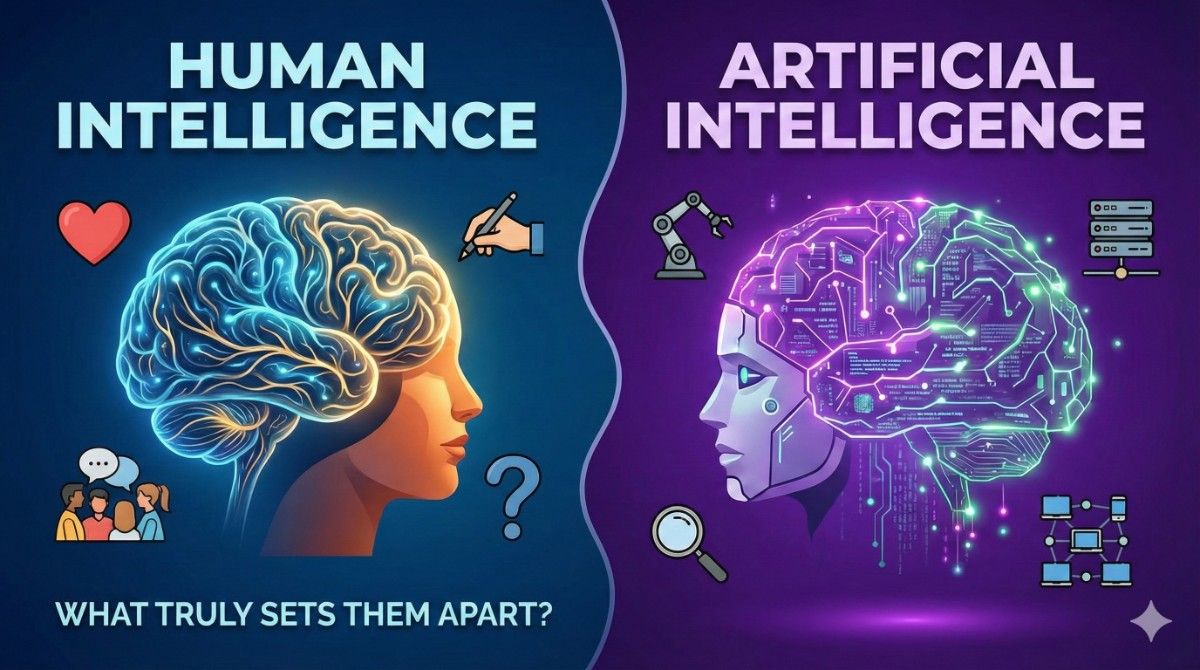
Human Intelligence vs Artificial Intelligence — What Truly Sets Them Apart?
In today’s fast-evolving digital world, Artificial Intelligence (AI) is no longer a futuristic dream—it is a powerful reality shaping how we work, learn, and live. But as machines get smarter, a common question arises:
How does human intelligence compare to artificial intelligence?
What Is Human Intelligence?
Human intelligence is the natural ability we are born with—a combination of:
- Emotions
- Creativity
- Intuition
- Critical thinking
- Learning from experience
- Understanding context
Humans can think abstractly, adapt quickly to new situations, and make decisions guided by emotions, culture, ethics, and personal values.
Example:
You can identify sarcasm, enjoy music, or feel empathy by understanding context—
something machines still struggle with.
What Is Artificial Intelligence (AI)?
Artificial Intelligence is a man-made system designed to mimic certain aspects of human thinking. AI learns from data, follows algorithms, and performs tasks with speed and accuracy.
AI is great at:
- Processing huge amounts of information
- Recognizing patterns
- Automating repetitive tasks
- Making predictions
- Operating without fatigue
Example:
ChatGPT, self-driving cars, face recognition, and spam filters.
But remember: AI does not have emotions, self-awareness, or personal experience. It only learns what we feed it.
Human Intelligence vs Artificial Intelligence — The Core Differences
1. Learning Style
- Humans: Learn through experiences, emotions, mistakes, and intuition.
- AI: Learns from data and algorithms. It cannot understand meaning—only patterns.
2. Creativity
- Humans: Create art, stories, inventions, and solve problems in unique ways.
- AI: Generates content based on existing data. True originality is human.
3. Emotions
- Humans: Feel happiness, fear, love, empathy.
- AI: Simulates emotions but does not truly feel them.
4. Decision-Making
- Humans: Mix logic with emotions and moral values.
- AI: Makes decisions using data-driven rules.
5. Adaptability
- Humans: Can handle unexpected situations instantly.
- AI: Requires clear data and training.
Where AI Outperforms Humans
- Speed and accuracy
- Handling big data
- Repetitive tasks
- 24/7 performance
- Predictive analysis
Where Humans Outperform AI
- Emotional intelligence
- Creativity and imagination
- Ethics and moral judgment
- Social interaction
- Complex decision-making
- Intuition
Humans bring meaning, empathy, and purpose—qualities no machine can replicate.
Can AI Replace Human Intelligence?
The short answer is No. AI is powerful, but it lacks:
- Consciousness
- Emotions
- Self-awareness
- Ethical understanding
AI amplifies human abilities but cannot replace the depth of human intelligence. The future is not AI vs Humans, but AI + Humans.
Final Thoughts
Human intelligence makes us unique—our emotions, creativity, curiosity, and ability to connect with others. Artificial intelligence enhances what we can achieve by automating tasks and unlocking new technological possibilities.
Together, they can reshape the future. But the heart and soul of innovation will always remain human.
People Also Ask
• What is the difference between human intelligence and artificial intelligence?
• Can AI beat human intelligence?
• Who is strong, AI or human?
• Is AI already better than humans?
• Who will win, AI or human?
• What are 5 disadvantages of AI?